.png)

The OCD
Clinic

Providing specialized OCD care in-person and online (across Ontario) for adults and children (ages 4+)
Landon's Bay, Mitchell Beattie
Understanding OCD
OCD is a mental health condition involving unwanted thoughts, images, or urges (obsessions) and repetitive behaviours or mental rituals (compulsions) used to reduce anxiety and distress.
OCD is misunderstood. It is not simply being organized, clean, or detail-oriented. Many people with OCD experience thoughts that are distressing, unwanted, and inconsistent with their values. OCD often thrives on uncertainty, fear, reassurance-seeking, distraction and avoidance.
This can create a cycle that feels impossible to break.
When OCD goes
Untreated & Unrecognized
Did you know? Most people with OCD spend years trying to understand their symptoms and find the right help. Research shows that 1 in 3 individuals wait 2–9 years before finding OCD specific care. This can leave individuals feeling confused, frustrated and hopeless for change.
Our therapists specialize in Exposure and Response Prevention (ERP), the gold-standard treatment for OCD. ERP helps clients step out of the cycle of obsessions and compulsions by learning to approach fears, tolerate uncertainty, and regain control of their lives.
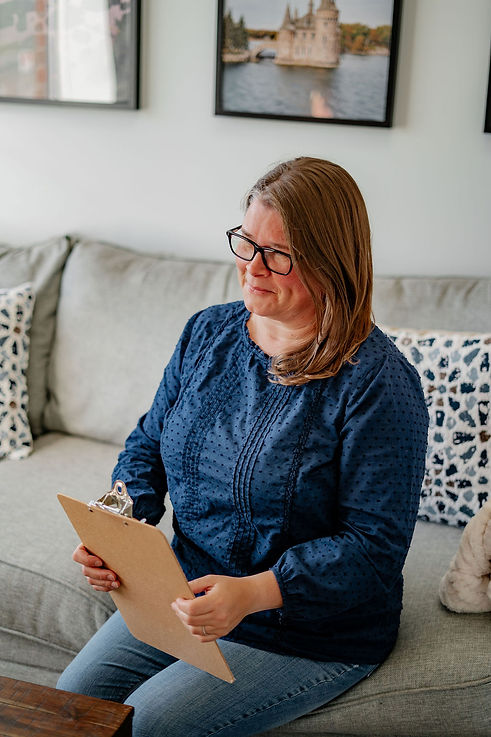
What is ERP?
Exposure & Response Prevention (ERP) is specifically designed for OCD. It helps clients gradually and safely approach feared situations, thoughts, and triggers while learning to reduce dependency on safety seeking behaviours (compulsions).
ERP involves:
-
Building insight into the OCD cycle and understanding how obsessions and compulsions are connected
-
Creating a personalized hierarchy of fears and triggers
-
Gradually approaching feared situations at a manageable pace
-
Learning to tolerate uncertainty and discomfort without relying on compulsions
-
Addressing feared outcomes and discovering that anxiety can decrease naturally over time
-
Developing confidence in responding differently to OCD
Treatment can be challenging — but it can also be empowering. We believe therapy does not need to feel intimidating or overwhelming.
Our therapists provide a supportive, compassionate environment where exposures are completed slowly, collaboratively, and at a pace that feels manageable. We make space for curiosity, compassion, and even moments of humour as clients learn to reclaim their lives from OCD.
OCD in Children & Adults
OCD can look different depending on a person’s age and stage of development.
OCD in Adults:
Adults with OCD may experience intrusive thoughts and compulsions related to:
-
Contamination
-
Harm (self or others)
-
Relationships (ROCD)
-
Pure Obsessional (Pure O)
-
Sexual Orientation (SO-OCD)
-
Religion or Morality (Scrupulosity)
-
Responsibility
-
Perfectionism
-
Checking
-
Health Anxiety / Illness
-
Existentialism
-
False Memories
-
Symmetry and need for things to be "Just Right"
-
Sensorimotor
-
Postpartum
-
Hoarding
-
Body-Focused Repetitive Behaviours (BFRBs), including: Skin-picking (Excoriation Disorder, hair-pulling (Trichotillomania), Nail biting and Lip or cheek biting
Adults often recognize that their compulsions may not make logical sense, but the distress and fear associated with OCD can make it extremely difficult to resist.
OCD in Children and Teens:
Children and teens may experience OCD differently. They may have difficulty identifying their thoughts as OCD-related or explaining what they are experiencing. OCD may appear as:
-
Repeated questions or reassurance-seeking
-
Avoidance of certain activities or situations
-
Rituals or routines
-
Emotional outbursts when rituals are interrupted
-
Perfectionism or fears of making mistakes
-
Family accommodation, where parents unintentionally become involved in OCD rituals
Treatment for children often involves working collaboratively with both the child and caregivers to help families understand OCD, reduce accommodation, and support healthy coping.
To learn more about the OCD clinic,
please reach out to intake@brockvilletherapy.ca.